The draft National Planning Policy Framework (NPPF), published in December 2025, is proposing significant changes to the local-plan making system across England. It envisions the local plan as simpler, more streamlined and digitally enabled that is kept up to date regularly, with the aim of achieving nationwide local plan coverage.
Currently, only 35% of Local Planning Authorities (LPAs) have adopted a local plan within the last five years. Resolving this problem will be essential if the Government wishes to achieve its manifesto promise of delivering 1.5 million new homes within the current parliament via a plan-led system. So, what do the reforms entail, and what are the implications for developers and LPAs alike?
The draft NPPF and the ‘Plan-led’ system
Both the draft and the existing NPPF (December 2024) emphasise that the planning system should be ‘genuinely plan-led’, in line with current legislation [1].
The consequences of failing to plan for the most up to date local housing need figure are already clear in the current Framework (through the tilted balance). The draft NPPF proposes to continue this approach, and then some. Draft Policy S5, for instance, proposes criterion (j) for major development to occur outside settlement development limits, particularly if the development would address an evidenced unmet need. Likewise, draft Policy GB7 proposes to expand the categories of development that are not inappropriate in the Green Belt to land around railway stations.
The incentive for LPAs to have an up-to-date local plan is, therefore, very real – the current Government is showing intent to exercise more power from the centre where local authorities are perceived to be falling behind in local plan and decision making.
The draft NPPF’s emphasis on speeding up and streamlining the plan-making process is to be predominantly achieved by introducing National Decision-Making Policies (NDMPs) to replace many local plan policies. Despite paragraph 16(f) of the current Framework stating that Plans should not ‘unnecessarily’ duplicate policies in the Framework (‘where relevant’), it is common for local plans to contain general policies which effectively restate national policy, but with slightly different wording. These policies are often included because it is perceived that they add an extra layer of protection to the development plan. Yet they end up significantly lengthening a local plan as well as its preparation and examination.
The draft NPPF is, therefore, unequivocal in its wording on this issue: plans should ‘Not duplicate, substantively restate or modify the content of national decision-making policies’ unless directed by other policies in the Framework.
LPAs will still be able to make policies going forward, but these will have to be site and location-specific, or only where there is a ‘clear and justified’ reason for inclusion.
The likely implications for developers in the short term will be increased opportunities for speculative development, which, previously, may not have been considered. In addition, the introduction of NDMPs should lead to a greater level of consistency in decision-making between local authority areas.
For LPAs, there will likely be greater political pressure to prepare and keep an up-to-date local plan to guard against speculative development.
New Plan-Making System
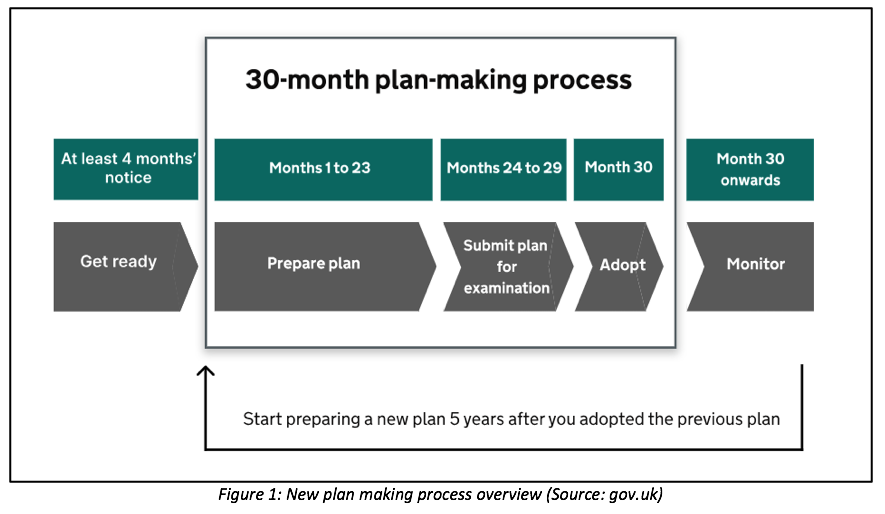
The Government’s new plan-making system is being implemented throughout 2026; LPAs will have until the end of 2026 to submit their local plans under the existing system, before that system is retired. As shown in Figure 1, the new plan-making system includes a 30-month timeframe for preparing a local plan, from commencement to adoption. It also requires LPAs to start preparing the next local plan five years after the adoption of the previous one.
These timescales will be monitored through a local plan timetable that each LPA must prepare under the Levelling Up and Regeneration Act 2023, and the LPA “must, at such times as may be prescribed, seek observations or advice in relation to a proposed local plan, from a person appointed by the Secretary of State.” (15CA,(3)). These ‘observations’ are translated into the three gateways referred to in the draft NPPF and in Create of update a local plan using the new system – GOV.UK: Gateway 1 is at the commencement of the plan, Gateway 2 is at the midpoint and Gateway 3, prior to examination (Figure 2).
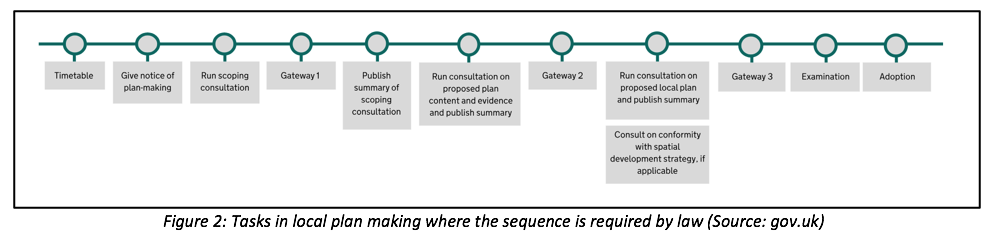
At Gateway 2, the LPA would submit their plan to an assessor appointed by the Planning Inspectorate, to receive ‘observations and advice’ on preparing a sound plan, in line with the tests of soundness in the NPPF.
Failure to progress on the local plan timetable could mean scrutiny and intervention from the Secretary of State for Housing, Communities and Local Government.
There’s no doubt the 30-month timeline is ambitious. Presently, it takes, on average, 7 years (84 months) for a local plan to progress from commencement to adoption under the existing system. To achieve a thirty-month timeline, therefore, would mean reducing the timescale by as much as a third.
The public consultation on the plan-making reforms in 2023 drew many negative responses from LPAs on the 30-month timescale. They noted the lack of resources, the lengthy political decision making and the difficulty of site selection, as the biggest barriers to quicker local plan preparation. There is no doubt it’s on its way, however: the government has announced that LPAs that do not intend to submit for examination under the existing system must give notice of their intention to commence plan-making by 31 December 2026, or by the time their adopted plan is 4 years and 8 months old, whichever is latest. They must then publish their Gateway 1 self-assessment by 30 April 2027.
The implications for LPAs are clear: in the short-term there is evidence of a rush from LPAs to submit their local plan under the existing, familiar system, before that option is no longer available after 31 December 2026. Secondly, we predict that LPAs will make the most of the period between announcing they’re commencing a new local plan (‘giving notice’) and starting the 30-month clock; this will mean engaging members, communities and establishing political and senior management support both at a local and sub-regional level (especially important in the context of emerging spatial development strategies) during a window of ‘at least 4 months’ before they pass through Gateway 1.
A notable absence in the Government’s guidance on the new plan-making system is where political decisions will need to be made. It is assumed, rightly, that the LPAs will take the lead in deciding when to consult and engage elected members in decision making during plan preparation, but it is such decisions that often slow down the process. As a result, we predict that key decisions will need to be made early in the 30-month timeframe to swiftly progress through the stages towards examination. In addition, we expect LPAs will need to undertake several workstreams in parallel during the early stages and prioritise the evidence preparation that is not dependent on member decisions to avoid abortive work.
Our advice to developers and applicants, therefore, is to get involved in the plan preparation process as early as possible, because it is likely that LPAs will need to make key decisions early to achieve the 30-month timeframe.
Supplementary Plans
The Levelling Up and Regeneration Act (LURA) 2023), replaces supplementary planning documents (SPDs) in the new local plan-making system, with supplementary plans (SPs). Whilst current SPDs are only material considerations in decision making, under the new plan-making system, SPs will form part of the statutory development plan. The role of SPs is, however, defined more narrowly than the local plan. SPs will be expected to deal with specific issues, either: setting out local specific design standards, or responding ‘positively and quickly’ to unanticipated changes in the area, between plan-making cycles. It is further outlined that SPs should not subvert the role of local plans, delay the allocation of sites within those plans, or duplicate NDMPs.
For LPAs, these changes reinforce the area- and site-specific focus of local plans. There will be fewer opportunities to introduce new policies and guidance, outside of the local plan preparation process, so it is all the more important that local plans include sufficient detail to allow development to come forward.
Developers and applicants should enjoy a greater degree of clarity with the introduction of SPs. For one, the new guidelines will provide more certainty by giving SPs the same weight as the development plan. The limited role of SPs will also streamline the planning process, by whittling down the number of individual guidance documents. On a separate note, the changes emphasise the importance of engaging with the local plan at an early stage, particularly for development within large strategic or regeneration areas. Otherwise, there may be fewer opportunities for engagement to take place outside of this process.
The consultation on the draft NPPF ends on 10 March 2026. If you have any questions about the consultation, please get in touch with a member of the team.
[1] Section 38(6) of the Planning and Compulsory Purchase Act 2004 and section 70(2) of the Town and Country Planning Act 1990.

James Isbill
Planner
BA (Hons) MSc
07552 243637
james.isbill@dlpconsultants.co.uk
dlpconsultants.co.uk
linkedin.com/dlp-planningltd